The space between two dots
How we see rest and recovery nowadays
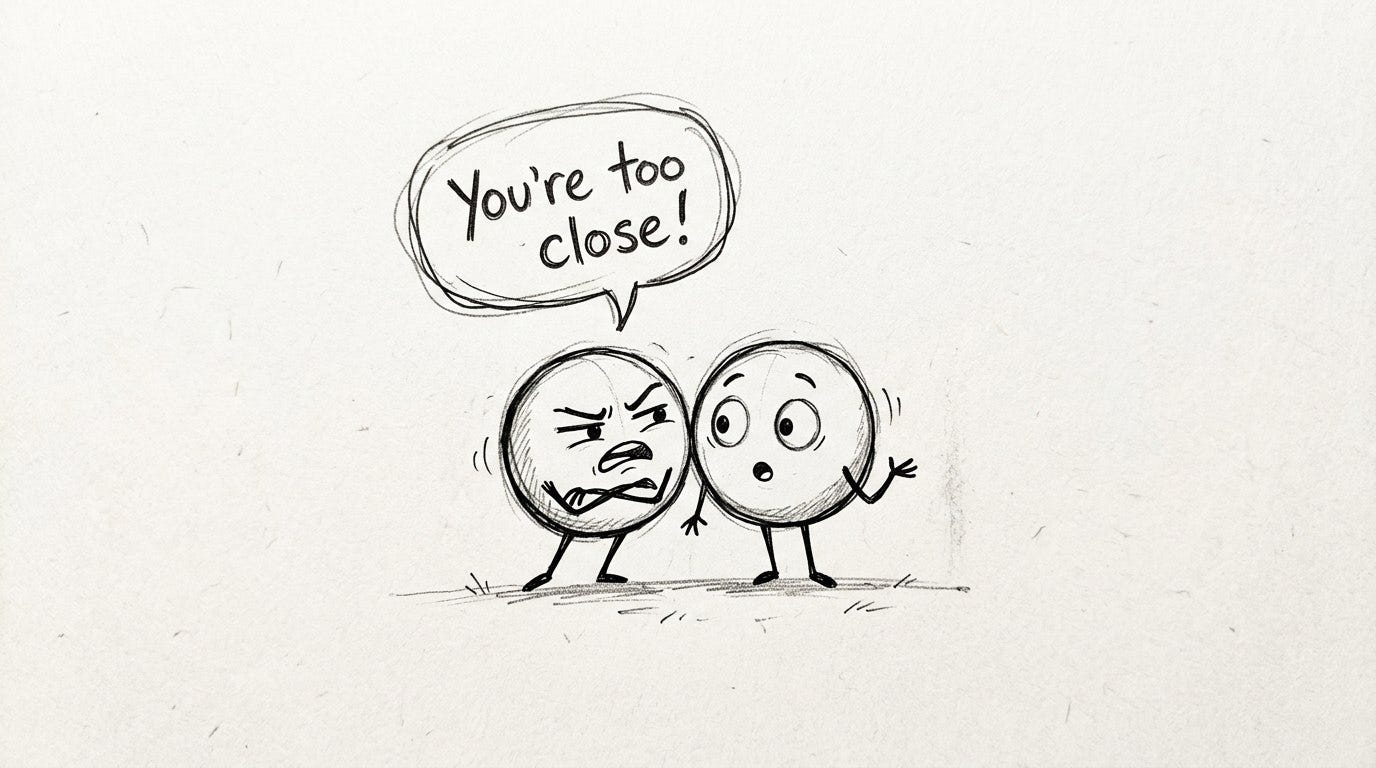
A thought that has been making the rounds in my head this week is about space and proximity, I live in London and by now like many others, I’m desensitised to big crowds.
Except, am I really? Or is it a survival switch it’s being triggered?!
While I was walking out of the tube in Oxford Circus, I was looking at people busy getting to work, most of them on their phones or looking at the floor, busy avoiding contact with one another.
As an average londoner I spend more or less 40 to 60 percent of my time in overcrowded areas, to go to work, to go to the gym, to cycle, to walk in the park trying to find solace and space away from humanity.
Even at home when sharing with other people we live in proximity, crowding a small space; unless, you live on your own or own your own place (see what I did there?), and even then, your neighbour might be having a loud phone call or traffic jam can disturb your peace even on a Sunday morning.
A study from 2023, pubilshed on Nature, linked stress to density and speed in crowds (Beermann and Sieben, 2023), meaning that all of this within time, compounds in a huge source of stress , which puts us in a fight or flight mode for the majority of our time in the day, with very little time to wind down
Sympathetic vs ParaSympathetic
Before we go ahead allow me a quick digression on sympathetic and parasympathetic nervous systems, the first it’s also known as fight or flight circuit, it’s your ancient brain’s pathway, and is hardwired for when running away from a imminent danger, like being chased by a tiger; the latter, also known as rest and digest, it’s related to the circuit which makes you feel relaxed while watching a sunset or after feasting laying down and taking a nap.
We tend to stay way too long in sympathetic nowadays, and its so sneaky and subtle we hardly notice it. It’s in the deadlines at work, in the full schedules we fill our diaries of, and to a certain degree to the proximity we have with people (think about when you’re in the tube packed with people, not the most comfortable experience and also very sympathetic circuit activating!) (Hayduk, L. A., 1978)
In nowadays busy lives we might need to prioritise more our para-sympathetic system, whether a little pressure and challenge is good for our lives, it’s also true that a constant pressure isn’t very good either, even if we numb ourselves to it, actually that, it’s even more dangerous…
It might not come as a shock but, stress, is one of culprit of poor cell replication in our bodies (Epel et al, 2004) . Our wonderful incredible bodies are constantly replicating cells to make up for the ones that aren’t working anymore, this process of replication isn’t perfect and we make daily an average 10K mistakes which are readily fixed by our immune system.
As you can imagine, it takes two to tango, one for us to put ourselves willingly and/or unwillingly under stress, and two, to our immune system to be overwhelmed by the amount of mistakes and our poor life choices.. it’s a vicious circle!
Chinese Medicine makes one point very clear: emotions are a internal cause of disease. What does this mean? That regardless our diet and inherited genetic dispositions, if we put ourselves in situations that overwhelm us emotionally for long enough they are equally likely to do harm.
Stress in particular is well defined in Chinese Medicine generally as: Qi Stagnation.
Qi moves, by definition, it’s ever moving and ever encompassing, when Qi struggles to move, inevitably generates pain and unease. So what's stopping it from flowing? Most often than not it’s us being on the way of our Qi.
We fill our days, hours and space with things: we buy, we live and we work with at every level of our lives, when the only thing we need most of the times is: space
Making space is an art, and also a skill, it involves knowing how to say no to gatherings when you need to charge your own batteries, to choose a walk in the park rather than a pint in a crowded pub, to go to sleep instead of binging on movies whilst burning the midnight candle.
My invite for both myself and you is to make space, as my mentor once said: a lit fire to stay alive, more than wood, it needs space.
Set your soul ablaze, make space, and observe yourself winding down.
I wish all of you and me more space.
References
Beermann, M. and Sieben, A. (2023). The connection between stress, density, and speed in crowds. Scientific Reports, 13(1). doi:10.1038/s41598-023-39006-8.
Epel, E.S., Blackburn, E.H., Lin, J., Dhabhar, F.S., Adler, N.E., Morrow, J.D. and Cawthon, R.M. (2004). Accelerated telomere shortening in response to life stress. Proceedings of the National Academy of Sciences, 101(49), pp.17312–17315. doi:10.1073/pnas.0407162101.
Hayduk, L.A. (1978). Personal space: An evaluative and orienting overview. Psychological Bulletin, [online] 85(1), pp.117–134. doi:10.1037/0033-2909.85.1.117.